Showing posts with label Non-Fiction. Show all posts

Thursday, September 5, 2013

Refuge: An Unnatural History of Family and Place


I bought Refuge for a nonfiction class at UVU (same class where I read An Elemental Thing), but it ended up not being read in class, and it took me until now to read it. Refuge is Terry Tempest Williams' female family history told alongside the story of The Great Salt Lake and her migratory birds. 
 
It was really hard for me to get into the novel. Chapters opened with different numbers, water level, number of birds, etc. Numbers are hard for me to comprehend, so the significance of the numbers at the beginning of each chapter was missed by me. It also felt like things weren't exactly in order, which was hard for me to understand. It was unclear when things were happening in the timeline. I also felt that Refuge has a very narrow demographic as to who would be most drawn to it. I know it's not something I would pick up off a shelf and take home myself. I give it 3 stars.

Monday, August 19, 2013

The Matrix and the Alice Books: An Intertextual Study

Title: The Matrix and the Alice Books
Author: Voicu Mihnea Simandan
Genre: non-fiction / movie studies / literary criticism 

Synopsis: The Matrix and the Alice Books presents aspects of intertextuality in three primary sources: the script of the motion picture The Matrix written by directors Andy and Larry Wachowski, and the books Alice’s Adventures in Wonderland and Through the Looking-Glass by Lewis Carroll. Intertextuality is a set of relations with other texts, which can include direct quotations, allusions, literary conventions, imitation, parody and unconscious sources amongst others. In The Matrix there are few explicit references to Lewis Carroll’s Alice’s Adventures in Wonderland and Through the Looking-Glass. This book by Voicu Mihnea Simandan presents both the explicit references and the less direct ones, giving evidence from primary and secondary sources. In doing so, it makes use of a literary construction developed from Gérard Genette’s structuralist theory of transtextuality as a framework to present how a web of intertextual relationships is clearly formed between the Alice books and The Matrix. 

Review: I enjoyed reading The Matrix and the Alice Books. It was written very much like a thesis and followed thesis structure very well. While it wasn't a super original idea (what is?) it was enjoyable and well researched, as well as something I hadn't really ever thought about. All the terms were well defined and it was very clear how The Matrix and Alice fit together and to read into the intertexual relationship of the children's stories and the movie. Everything was well thought out, ideas were fully developed, and it was well presented. It was easy to read and understand, even without a thorough knowledge of The Matrix or either Alice book. I look forward to reading his upcoming novel: The Buddha Head.  I give The Matrix and the Alice Books 4.5 stars for its genre.  

Author’s Bio: Voicu Mihnea Simandan is a Romanian writer and freelance journalist who was 
born in 1978 in Arad, a small city in Transylvania. He has published short stories, non-fiction, and books for children. He has been calling Thailand home since 2002 and he has been a member of the Bangkok Writers' Guild since 2009 and a member of AP Writers since 2012. He is now teaching Language Arts and Social Studies at an international school in Bangkok. His upcoming debut novel, The Buddha Head, a suspense thriller set in Thailand, is scheduled for publication in late 2013. He loves archery, martial arts and travelling.
Author links: Facebook/ Twitter / Goodreads / Blog / Website
Giveaways: For each tour stop, the author will give to the most engaging commenter an ecopy of The Rage of a New Ancestor, a collection of short stories set in Asia, where Voicu Mihnea Simandan also has one contribution. The author will be awarding a $10 grand prize to a randomly chosen commenter during the course of the tour.For each tour host, the author will give an e-copy of Mr. Cheng’s Silver Coffeepot, an anthology of Asian short stories, where Voicu Mihnea Simandan also has one contribution.


I am a book tour host with CMBook Tours: I received a complimentary e-copy of 
this book for the purpose of review. All opinions are 100% my own.

Tuesday, July 16, 2013

An Elemental Thing

I initially read An Elemental Thing by Eliot Weinberger as assigned reading for a non-fiction class in college. It is in a short-story/prose format, with each piece able to stand on its own. I didn't find the reading to be quite poetry, nor do I ever really find myself liking poetry, but it was more like "Interesting Facts Weinberger Knows (and now you do, too)", which was okay by me. It's a fairly easy, semi-quick read, and I liked learning all the random facts. But at the same time, It wasn't especially meaningful. It isn't necessarily a book I'd recommend, but it's not a book I'd stop anyone from reading, and it's not a waste of time. So, three stars. 

Tuesday, March 19, 2013

I Hate It When Exercise Is the Answer

I Hate It When Exercise Is the Answer by Emily Watts is a sort of self-help book, designed for you to rad a chapter a day and implement the small changes into your life. It's got some really good ideas. Watt's ideas are more for a professional or a mom, though, not necessarily an in-between-er like me.  But with a little adaptation, it can be a helpful read for anyone. 

Monday, March 18, 2013

The New York Regional Mormon Singles Halloween Dance

A few years ago, I took a Mormon Lit class at UVU.  It was a really interesting class and exposed me to new novels. Comedian Elna Baker's The New York Regional Mormon Singles Halloween Dance was not a novel we read in that class, but our professor talked about it to us one day and read us an excerpt.  After hearing Baker's voice come to life via my professor, I had to get my hands on it. 
New York Regional is a hilarious yet touching memoir by a born and bred world-traveling Mormon. Her sense of humor sort of reminds me of Chelsea Handler, but not as crass. So I recommend this book with the caveat Baker uses in her dedication to her parents: " . . . aside from the nine-F words, thirteen Sh-words, four A-holes, page 257, and the entire Warren Beatty chapter . . . You might want to avoid chapters twenty-one, twenty-two, twenty-three . . ." 
Read on! 


Tuesday, January 22, 2013

Mockingbird


I picked up Mockingbird by Charles J Shields because of my deep, undying love for To Kill a Mockingbird and Harper Lee.  I was sorely disappointed, and I'm sure you will be too.  It basically states all the connections (which I already knew) between Harper Lee and Scout.  Basically To Kill a Mockingbird is like her life. Scout's friend Dil is Harper Lee's friend, and fellow author, Truman Capote. The novel is basically a fictionalization of her life.  Even the Radleys were based on a real family, which I didn't know, so that part was interesting, but it dragged on for ever and ever! There was a nice bit about how Lee worked with Capote on In Cold Blood, which I also didn't know about, but again, my! Shields drags on! 

Another issue I had with Mockingbird was that Shields didn't have Lee's input or permission or approval or anything to write about her life! The novel had no new information from Shields; it was more like a thesis paper with too much research.  It was long and boring and I felt like there was no point to reading, and there is certainly no point in me recommending this novel to you! 


Read my post on To Kill a Mockinbird here: http://jaymesbookreviews.blogspot.com/2012/09/to-kill-mockingbird.html

Wednesday, August 1, 2012

Travels with Charley: In Search of America

"A journey is a person itself; no two are alike"

I promised you Steinbeck, so here we go! 

Right off the bat, I knew I would like the tale of Steinbeck's journey across America.
The old owner wrote: "We see things as we are, not as they are."
Truth. Beauty. Steinbeck. 

Steinbeck drove across the country [starting in the north-east] because he "needed to discover all of America." He got himself a travel truck and named it Rocinante after Don Quixote's horse, which implies Steinbeck likens himself to Quixote. He is to travel alone with only the company of his poodle, Charley. He even left his wife at home, with only a mild break, from both his travels and his loneliness, in Chicago when the wife flew out.

Steinbeck had some really interesting insights in America. He writes: "Yellow Stone National Park is no more representative of America than is Disneyland." I can't say that I agree with Steinbeck's assessment that they are not representative of America, because I think that they both are representative of America and it's people, especially of tourism and travel, but also the things we as Americans like. 

Steinbeck also feels that American's have no roots. This is because we are descended from people without roots. The very people who founded America left because they didn't have roots, and so we are a rootless people. Those with roots stayed where they were. I'm not sure how I feel about this assessment, though he makes a good argument for his position. 

On his way back home, Steinbeck first travels through the South. Now, remember, this was 1960, so he encountered some unique perspectives on race, from both directions. In order to see these perspectives, he never revealed what exactly he thought. 

The end of his journey kind of fizzled out, and the book definitely reflected this of Steinbeck. It was just like he ran out of gas. He was tired. He was ready to go home. There was no real conclusion. It was just a journal of his experiences and loose interviews as he journeyed across this "New America" which did not live up to his expectations. This may be, at least in part, because of Steinbeck's age and heart condition. Thom Steinbeck, John's son, gives that as the reason for the trip in the first place. John wanted to see his country one last time, and Thom was a little surprised that the wife let John go on the trip alone because of his condition. Thom says he could have died at any time. This heart condition would have definitely come into play in Steinbeck's growing tired and wanting to come home.

Now, many folks find Travels with Charley to be a work of fiction, and maybe it is. Or maybe, in my opinion, Steinbeck is recounting his experiences, his truth. Maybe it didn't happen exactly as he said it did. Maybe he was an old man waxing sentimental about the country he loves. But we must take all memoirs or personal tales with a grain of salt! And this was a fairly enjoyable one, with just a titch of dry parts. So, you know, a regular memoir. I jest. But I do recommend this book if you love memoirs, Steinbeck, or America. 
Read on, my friends. 

Friday, June 22, 2012

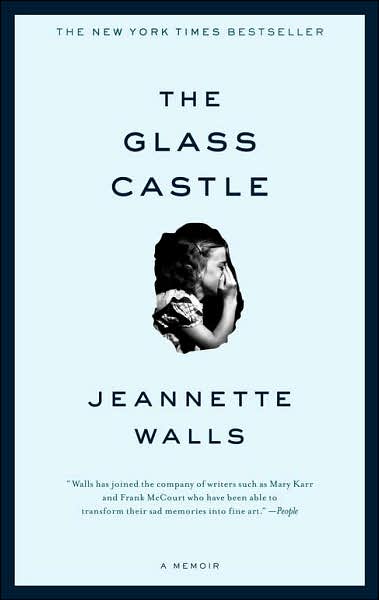
Glass Castle


"Walls has joined the company of writers such as Mary Karr and Frank McCourt who have been able to transform their sad memories into fine art." - People


Compared to Frank McCourt, I much more thoroughly enjoyed Jeannette Walls's memoir, The Glass Castle.  Though I've never read Mary Karr, so I can't compare, I did enjoy the tale of the unconventional and poverty-stricken upbringing of the Walls children by their uniquely dysfunctional parents. The Walls' parents chose an alternative lifestyle for them and their children which they saw as beneficial; the children only learned to pull themselves up by their bootstraps to break the cycle. I couldn't put down this heartfelt memoir. 

Monday, June 18, 2012

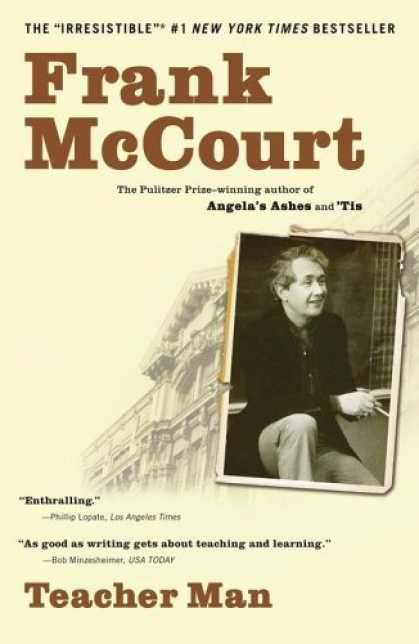
Teacher Man


Teacher Man is Frank McCourt's final memoir. It is still disjointed, like 'Tis, but not as bad. It is more of an elaboration on the teaching aspect of his life, so it was a little more enjoyable to me. Regardless, I still recommend it with the catch as before -- only if you like Angela's Ashes more than I did! Read on!

Night


Night is Elie Wiesel's tale of his life and experience surviving the Holocaust at the death camp of Auschwitz. To be completely honest, I didn't really like it. But how can you analytically critique someone's heartfelt story? Is it cruel to dislike a personal memoir of the Holocaust? It's really hard to compare one person's pain to another, but Night is not one of the most touching, shocking, or what-have-you holocaust novel I've read. He didn't come alive to me, as Anne Frank does her diary or the characters in Devil's Arithmetic do. Maybe there was a problem in translation? Night wasn't originally written or published in English. Maybe I've read too many novels about the Holocaust? I've read a ton; maybe that's made me hardened to it? Maybe I'm not a sap anymore? Okay, that's not true, because I almost cried at the middle school while going over the end of Anne Frank. But I just didn't really enjoy Night. It seemed rather disjointed to me. This is not to say it didn't have a good message, because it did. Wiesel teaches peace and equality. He sings his father's praises, as his novel is just as much about his relationship with his father as the camps they were in. Night  has a good message, but is not one of my favorites. Read on!

'Tis


'Tis is Frank McCourt's sequel his memoir Angela's Ashes and continues on with the story of his life. To be completely honest, I didn't love it. I'm not sure I even liked it. It felt really disjointed and was kind of boring. It didn't pull me in. I really couldn't relate to Frank and I felt like he made a lot of the problems in his life. He made some bad choices and made his life harder than it needed to be; it was hard to sympathize with him and enjoy the book. I only recommend this book if you enjoyed Angela's Ashes more than I did, in which case you will also enjoy 'Tis more than I! Read on!

Friday, June 15, 2012

The Education of Little Tree


The Education of Little Tree was recommended to me by one of the English teachers at the middle school. It is a memoir-style novel that may or may not be true. Asa Earl Carter published under the pseudonym of Forrest Carter, and after his death his brother said that the family had no Native American heritage despite the story line. There's a lot of controversy surrounding this novel, not only because Carter's story being a fictional work posing as a memoir. Carter was involved with the KKK and The Education of Little Tree is reputed to be his deathbed repentance.

Whether or not The Education of Little Tree is true or false (I vote false), it has a good moral and teaches a good lesson. Little Tree's parents, one white and one Cherokee, die and his Cherokee grandparents take him in and raise him.  They teach him their ways of simple living, tradition, love of nature, and to "spread the good." They make efforts to educate themselves and place emphasis on Little Tree learning by experience and making his own choices. 


Personally, I think the history of the author does not negate the message of this novel. I wouldn't say it's my favorite book, nor would I have picked it up on my own, but I found it to be a good read enjoyed it. Read on!

Thursday, January 12, 2012

The Zookeeper's Wife


One of my dearest friends recommended this book for me after she loved it. It's a war story, surrounding WWII, dealing with the German invasion of Poland and the ghettoization, concentration, and killing of the Jews.  Zookeepers Jan and Antonina Zabinski struggle to raise their family and save their zoo, all while hosting an array of Jewish "visitors" on the zoo grounds. It's an interesting story, and clearly heroic, but I honestly found the writing a little dry. There was a lot of (to me) unnecessary background information. It felt more like a senior thesis than a book. However, it is non-fiction, which is usually on the drier side. I just was expecting it to be a little more exciting. Sometimes I think maybe I have this problem where I want all books to be fiction? But I do enjoy autobiographies. So I'm just not sure. Maybe I'm the problem? Either way, this was a good book, just not exactly a thriller. I give it a half-hearted recommendation. Read on!


Tuesday, January 3, 2012

My Lucky Life In and Out of Show Business


I have a great big chimney sweeping, car flying, singing and dancing crush 
on one Mr Dick van Dyke.
Let's be real- Who doesn't? 
He's amazingly talented, even in his post-retirement age days.
He wrote this book about himself, and I absolutely adore it.
And him.
Oh Dick, I swoon.
He's quite an amazing man, in addition to the song-and-dance man
we all know and love.
His life has truly been lucky; he is so lucky.
He married his high school sweetheart and stayed with her almost 
entirely through thick and thin. She gave him four children. She stayed with him during the early, struggling years. And when they parted, he made sure she would want for nothing.
The one thing I admire most about Dick?
He made a promise to never be in anything he couldn't watch with his children.
He didn't want to tarnish his name or his character.
And you know how we all like Chitty Chitty Bang Bang but it's kind of missing that Disney Magic? That little spark that just makes you sit in awe and wonder? 
Dick knows that too. He actually turned it down quite a few times before he agreed to it.
I just love this man. 
All I want is one last Dick-and-Julie song-and-dance classic.
Dick? Julie? Robert Iger? Can you help a sister out?
I think Walt would approve!!!

So anyway, if you love Dick as I do, read this book. Watch Mary Poppins.
.: magic :.

Tuesday, December 13, 2011

Mennonite in a Little Black Dress


Mennonite in a Little Black Dress was definitely not the book I thought it would be. Rhoda Janzen is no Elna Baker or Chelsea Handler, which is what I was expecting. Everything I had heard, and even the cover and title, was misleading. It was not the tale of a sheltered Mennonite trying to navigate life with the gentiles. It was a tale of going home in your 40s after a bitter divorce. 
Really, it just hadn't been pitched well to me. I was expecting something different than I got, which led me to not really enjoy this book as much as I would have otherwise. I really hate it when something get so worked up you can't enjoy it in its own right. Case in point. Read on! (but read this before you read Elna or Chelsea! They're funnier.)

Thursday, September 8, 2011

Angela's Ashes

So my amigita favorita had the lovely idea that we, along with another chicita bonita should start a book club. [I'm the only non-ginger allowed, so back off! :)]

And so we read Angela's Ashes.

Angela's Ashes 

Not gonna lie. I legit picked this book up on a dollar day at the bookstore with no idea what it was about. I just looked at the cover and assumed it was a holocaust novel. My bad. So it was sitting in my pile-o-books-to-read when Nat suggested our book club and reading this. However, with the wedding and the moving and the honeymooning and the five other books I was reading, Angela's Ashes took a back burner. 

My first thought on finishing this book was that I clearly need to read Joyce again because I'm starting to think all Irishmen are the same.  But seriously.  Near the end of this really started to remind me of Portrait. Maybe Stephen Daedalus knew Frank McCourt? Okay I'm being ridiculous. 
My second thought was "Why is this book titled Angela's Ashes? I don't get it!" 

But I did enjoy this book. I didn't speed through it, but I did read it rather quickly. I do recommend this book. It also has a sequel, apparently, which is now going on my list.  

But really. Anyone know why a nice gent like McCourt would title his memoir with his mother's name?